The fool
Charles Ray, Boy with frog, 2009

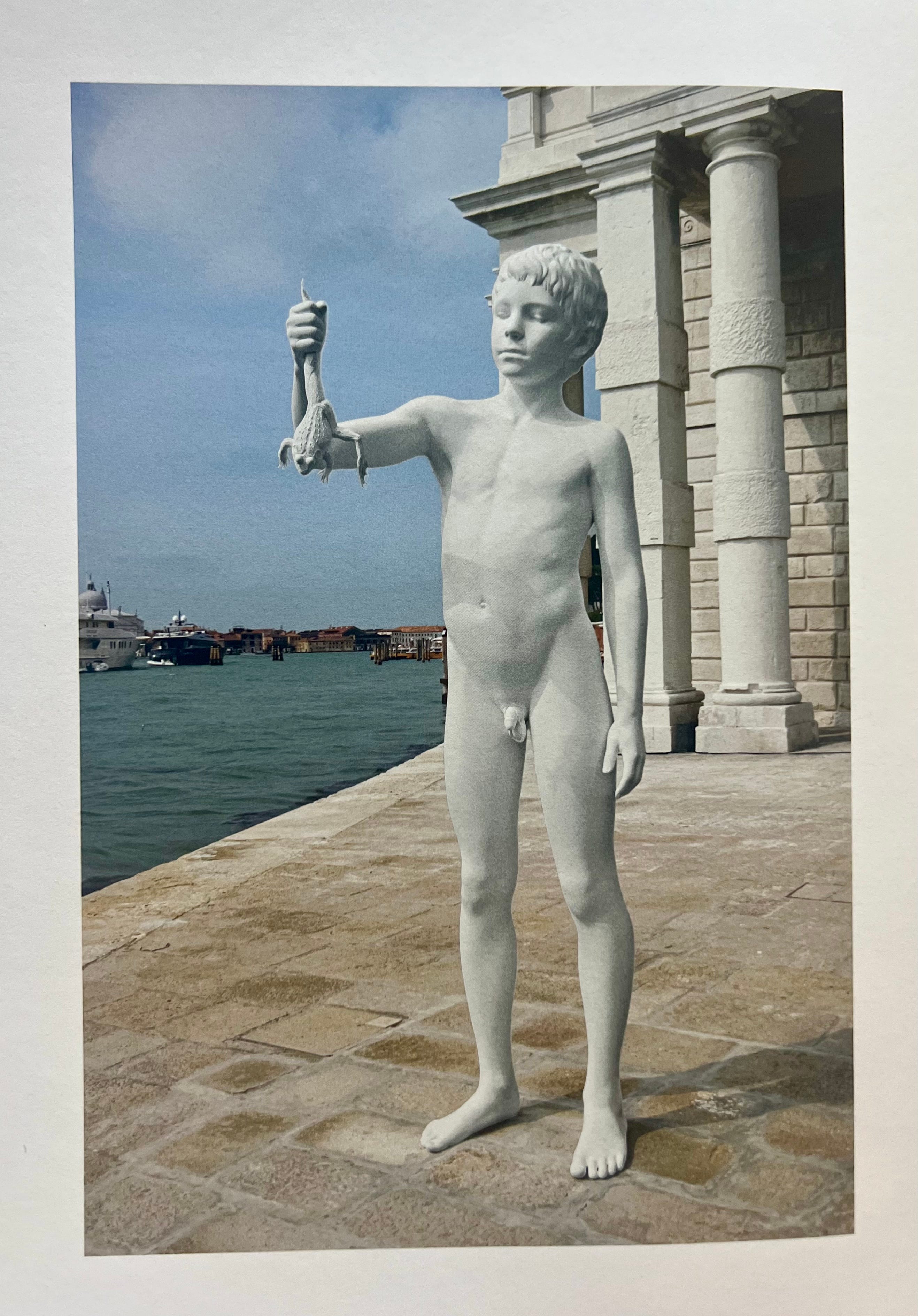
Some time ago, last year in fact, when the seasons began to shift in a foreign place and the year had made it’s choice, decisively, to begin winding itself up to a close, I was on the isle of Hydra, in Greece, for the first time. Hydra homes the escapees, the fated, the wayward people, the indecisive tourists, the poets, the bohemians, the writers, the marxists, the agitators, the looters (kidding), the professional middle class who want a brief reprieve from being seen as middle class; it is the famed home of literary salons run - strangely - by Australian writers. Here no cars are allowed, donkeys with saddles and traveller sacks meet you at the port, and everyone walks around at half speed, looking sideward like they’re about to have a meaningful affair, recounted 20 years later in a bad novel which suspiciously takes the form of “autofiction”. Those who have spent time there will happily tell you of the way you can hear the entire town’s noise drifting up to the church at its peak, because no automobile noise is permitted to extinguish it. They tell it like it’s a novelty, when the reality is that there are simply no roads or cars that exist there to do so.
Being in Greece slightly past the major peak of tourism season is quite pleasant, and I would recommend it; the travellers with main character syndrome as their primary narcissistic damage are slowly wheeling away back to their home countries, and the usual recuperative power of the local economy (and of locals) is beginning to take precedence again, so you witness both the public and private sides of the island in a way that might have been easily overwhelmed (and thus, concealed) during its peaks. I like being on the cusp of things, existing ever so slightly to the edge. It’s here where I’ve found the freedom to solicit my own impressions.
Before this I had never been to a Greek island, and in this sliver of time I had available had committed to going to exactly 4, though if I’d told you what they were, here, you might find it slightly random. I followed no intuitive traveller’s logic. (I ummed and ahhed over which ones were the best and took impossible steps to reach them.) At this time, on Hydra, you could feel the locals starting to reclaim their own island, or at least the parts of it that don’t need to be “performed.” Either it’s quieter, or it’s a time where I gain the ability to listen and see better. You welcome various glimpses of an uncompromising life: A teenage girl hanging laundry with her earbuds in. A priest smoking out the back of a building where light from thatched windows cuts across his figure. A crowd of identically dressed women swanning in and out of bars and emerging that much more harried by the end.
It was a late, lazy summer, with light pointillistic and expressive on the pavements near the harbour, and languid boomers in cargo shorts, sunglasses, and bucket hats wandering back and forth in that lolloping, xanaxed way they often do. That many of these boomer tourists were Australian explained the way they wore their clothing like a declaration of war on the concept of “taste.” As in, the kind of men who think ordering a Metaxa in Greek while not knowing any other significant features of the vocabulary makes them the present day embodiment of Plato. I had been flown overseas (called there, if you want the drama) to do some light documentation work for a writers residency I had participated in last year - this time being at somewhat of a remove from the program, as I had to capture discreet moments, expeditions, and research trips that each cohort was doing. In the time in between some of the programs, I had about a week and a half to spend doing my own thing.
Ten days is either too long or not long enough to be alone. Hydra, being the first island on my destination list - on account of its literary history, but also its closeness to Athens - was the first to make a sizeable impression. I was hardly the first writer to have attended without real reason to go. The island is known for fostering the creative inclinations of its visitors, and more than one Australian writer, actually (Charmaine Clift, George Johnston) had travelled there, or lived there, for an extended period, though most know of it as Leonard Cohen’s greek getaway. Why this happened, I’m not entirely sure. The combination of its cheapness and proximity to mainland Athens is probably responsible, as its untroubled nature. So much of the “writing world” and its bureaucracies actually create conditions that are hostile to the creation of real, breathable, quality writing - a contradiction I’ve often found hard to reconcile. To escape those confines and make it to such a peaceable island makes, in some way, perfect sense.
Partially as a result of this history, the Hydra Book club was set up on the highest floor of the Hydra museum, where on a few days a week a man called Joshua sets out some of his own personal favourites of both Mediterranean and Antipodean literature, with some other choice selections on a theme scattered through their midst. I believe he might originally be from NYC, and splits his time between the two places, but I was either too self absorbed or lost in my own narrative to understand. Because I was at the bookstore, I often started seeing the same people again, then pretending not to when we passed in the street, which is, I think, a good explanation for the true rhythm of islands.
On my last day, after getting lunch at a place past one of the farther corners of the town square, I saw one of these guys with a friend of his, and said hello briefly as they passed. Later, he messaged asking how I was doing, and would I like to come and meet his friend and him for a swim? It was then that I thought - had I even swum here? Isn’t that the first thing people do when they get to an island? But of course I hadn’t, because I’d been working, or I was existing in refuge from that work by pretending to, or I’d been seeing friends that were there, inexplicably, at the same time as I. I had wanted to spend some of my time off writing, and in those 10 days I mustered little more than a sentence. It is an easy cliche to repeat that the best writing comes to you when you’re in contact with real life, rather than the page or screen.
Down near the rocks, where other swimmers were coasting along gentle pressures in the water and others were creating ribbons with their movements, we laid towels haphazardly, and looked skeptically around the area to see if doing so would even be possible. We spread our towels like trespassers pretending to belong, checking to see if “the beach” was, in fact, a beach. It wasn’t. It was a clever approximation: a narrow landing of stone at the end of a long descent down some ancient (or what felt like ancient) stairs. I think I had been recently tattooed on my wrist, but I didn’t want to miss out, so I floundered around in the water for a short amount of time to take advantage of the occasion, like a statue broken off at the base bobbing along the waves, stroking only occasionally so as to not get my hand underwater. That would have lasted all of 10 minutes. It was enough for me, as I am easily satisfied.
When I returned back to the rocks, I watched my two newish friends swim a little bit more and return to “the shore”. Even though I had been invited along, and the invitation extended was perfectly cordial and completely absent of any cynicism or judgement, I still felt a perceptible sense of distance from these two people, who maybe would not have bothered extended their hand to a stranger if it was in their home city. Though maybe I was just projecting - paranoia, of course, can easily betray itself as a form of self absorption. Our conversations, in their introductory choreography, carried an all too formal dictation that made it hard to tell how they felt about me, and maybe my being Australian and randomly being on this island under a different context struck them as dubious, which I would have honestly found hard to deny; I didn’t even really have a clear justification for being here, except for its own sake.
As if to interrupt this strange dynamic, the woman - of course she wore Celine, of course the shirt she had drawn elegantly over her swimwear was white and expensive - turned to me and offered me a tarot reading. There was no preamble, no soft passageway into this suggestion. And yet I was grateful for the interruption. Something about this shift in conversation suggested a change of fortune, and a different direction to the politesse of our other chatter, which felt overly restrained, pleasant, and scripted in nature. It was as if by doing so she allowed a door to be opened where the esoteric could now enter. Something had dislodged within the abbreviated, psychic space that flowed between us. All of a sudden we were standing on level ground. I found myself suddenly eager, and seeing this response in me, she relaxed. Levity was now permitted. I shuffled the cards, handed the deck back to her. From her hand, I picked one, and she flipped it. She emoted pleasantly.
“The fool.” She said, and smiled, optimistically. I think I probably said, “oh no.” She quickly tempered my hesitation. “This is a nice card. I’ll give you the reading. The fool generally means a beginning of a new journey, one where you will be filled with optimism and freedom from the usual constraints in life.” She said. “Grave danger awaits him, and certain peril, but due to his light-hearted nature, he knows not of what awaits him, and is ultimately protected from harm.”
She continued. “Others may try to ransack the fool, or take from them, or in other ways attempt to cause harm, but their efforts are in vain, because whatever is lost from him is endlessly replenished; as there is an endless well-spring of optimism from within that he generates, and it is ultimately his antagonists who are made to seem foolish, as the fool can escape all that seeks to impose restrictions upon him.”
–
In the official imagery, the fool is depicted as a young, somewhat gender neutral figure. Usually they’re donned in a tunic, playing a lightweight instrument like a flute, a small, playful dog following at their heels, unaware that both of them are poised to fall from the cliff one step away. The nature of their innocence seems to betray a complete lack of awareness of the dangers that might befall them. Nevertheless, it’s considered a lucky card to pull, if not the luckiest. As if to be exactly within the line of fire and remain somehow unbothered is to be exactly where you need to be. To be poised at the cliff’s edge is to understand that control is mostly decorative. Which is to say, “the fool” is the best representation of having a type B personality.
It’s funny. Since receiving this reading, I’ve scoured the web - and consulted many tarot sources (which exist on the web… ) - about the meaning of “the fool” since this felt so specific, and uncannily relevant to my life and the period I was in, but nothing like this exact, specific reading comes up. There are references to the aforementioned youthful, naive, but ultimately well intentioned figures moving into the realm of danger while being protected from the threat of that same danger. There are references to those who might be on the precipitative edge of some new, unusual and fantastic voyage. It’s fine - I understand why the repetition insists on itself, as it’s a nice metaphor. But the singular nature of that reading, and its somewhat pointed interpretation, has stayed with me - never mind that it’s always the readings from completely random women who fulfill the spirit of the tarot, rather than official readers. It’s as if you lose the power to embody the principles as soon as you deign to give yourself the title.
The reading demarcated in me a sort of founding principle that had organised my life, then, in favour of a new sensibility that I tried to hang onto from then on, creating a sense of event that served me for the coming months, and offered a framework for interpreting hardship which allowed me an out from the easy answer, ie, a narrative of self-victimisation. I always felt some kind of delayed onset shame about my most playful characteristics, fearful that they would be cast as naivety. I’m sure to others, to friends and family, this attitude seems like the same one that leads me to disaster; to me, it has protected me from the fallout.
To write here about the almost absurd, comical, seemingly endless litany of unfortunate events that have befallen me in the last year and a half would risk coming off as a kind of fraudster or spiritual hypochondriac that had no ability to control their life, when so much of it was just plain bad luck. I could not phrase it any other way. But I’m sure if I were to rattle them off, casually, in a litany of collected misfortunes, it would sound horrible: I got food poisoning on the plane to Athens and landed in hospital, I was T-boned in my car at the beginning of the year while I was driving away from the beach, I had my identity stolen and my phone number “ported”, and money swiped from my bank account, someone then used that phone number to impersonate me and access my details. At some point you reason that you are the common denominator and don’t want to project an image of yourself as chaotic or ungovernable in order not to drive people away. It was like I was living my life in a state of constant admin to account for the accumulative aftershock of these happenings. (In the case of dealing with insurance companies, as anyone will tell you, this reading could not be more impossibly literal.)
If I was stuck in that frame of self victimisation, my thoughts would have necessarily created the world, as many claim they do. I would have “created” a “narrative”. The narrative would’ve asserted itself over the vulgar realism of what was going on, obscuring the finer details. The fantasy of vulnerability would not, in this case, have served a crucial purpose. My kneejerk response to what happened might have been to play it up, as if the ill fortune of my year needed to be seen - mentally, at least, in garish detail - to be believed. Maybe I would have leaned into the sense of misfortune, where every failing is a cosmic conspiracy, and nothing is your fault because you’re the protagonist of some existential drama, even trying to convince my friends what was happening to me, to feel some sense of affirmation in the strangeness of these events, to earn the gold star victim card. It might be easy, you’d think, to let your surroundings dictate to you how you’re supposed to feel about yourself, instead of creating the inner self, that inner weight, to keep you grounded. But, what is even more uncanny about the strew of bad incidents, and maybe more miraculous to me, is that barely any of them left an impression. After returning home from Bali I had my credit card stolen and used, and then in NYC I landed in emergency after discovering I had a lower bowel obstruction, which I attribute either to dunkin donuts coffee (like liquid lead, and unpleasant to feel the effects of if you’d made the decision to purchase it impulsively) or the corner store protein shake I drank (which we have all just discovered contains literal lead). All of these events are totally bonkers, and maybe some of them could have been avoided if I’d had better foresight (probably?) but more or less they were the result of crazy bad luck.
What gets me, though, and the point of me writing this, is that almost none of these things ended up affecting me in any major way. There was always some friend, some nurse, some advocate, some strange stroke of luck that swooped in at the last moment to interrupt the possibility of serious damage. And I wonder how much of that had to do with the attitude I’d been trying to foster since that reading. Shortly after leaving the hospital in NYC I went to a psychic near the west village to get a reading, because I genuinely thought I was in the midst of some divine comedy that could not be explained in the usual, terrestrial was. She claimed that no divine force was protecting me, and that the “bad energy” was not even mine, but the intentions of others had no ability to properly harm me or leave a lasting affect. She also told me I needed to pay 800 american dollars for a meditation course in order to free me from the curses that kept befalling me, but that is neither here nor there.
–
When I have travelled, I’ve often been warned by the knowledge that, outside the comforts of modernity and the safe, often suffocating bubble of dependencies and routines I’ve forged, I am perfectly capable of handling myself. In the face of risk, uncertainty, and misfortune, it is easy to retreat into our protective shells in pursuit of some kind of assurance of safety. What happens is some continual form of self abandonment - looking for security in the words of preachers, or influencers; in the assuagement of routine and the reliability of external structures; the cogs of modernity turning to keep us coming and going. Many of these instruments are crucial, and there are reasons we depend on them to exist. There is, however, a small problem. As soon as we palm over our sense of “security” to an external source, we are sending a message to ourselves - our unconscious, our nervous system, whatever - that we intrinsically cannot handle difficulty. This could not be further from the truth, although the “trueness” of its message can easily penetrate. I’m sure that there’s a correlation between the increasing chaos of the world that younger, middle class people think the continued abdication from self makes us more fearful, more childlike, until we become the kind of person who says “let people enjoy things.”
En route we are free of these small assurances. I have often been empowered by the knowledge that I can withstand the unexpected. There is no feeling, no challenge, no change in circumstance that my body is unable to handle. When you tap into that feeling, wonder abounds. That sense of an inner direction, a clear look to the self, feels harder and harder for me to get in touch with. I know why, though I barely want to admit it. I mentioned the cheap comforts of modernity (and to that end, suburbia, and technology) but there are at least 100 apparatus that exist within our lives that encourage us to draw our attention. To return, over and over again, to the way the feelings exist in the body is to notice how the voice is not one voice but many, and can be heard in harmony when not conceived of as a threat. This kind of language feels central to many of the problems people have with therapy speak, but there are other costs. That sense of levity carried by the fool is its own reward.