Self-titled, or thinking about spotify (Or, say you never went down the rabbit hole)
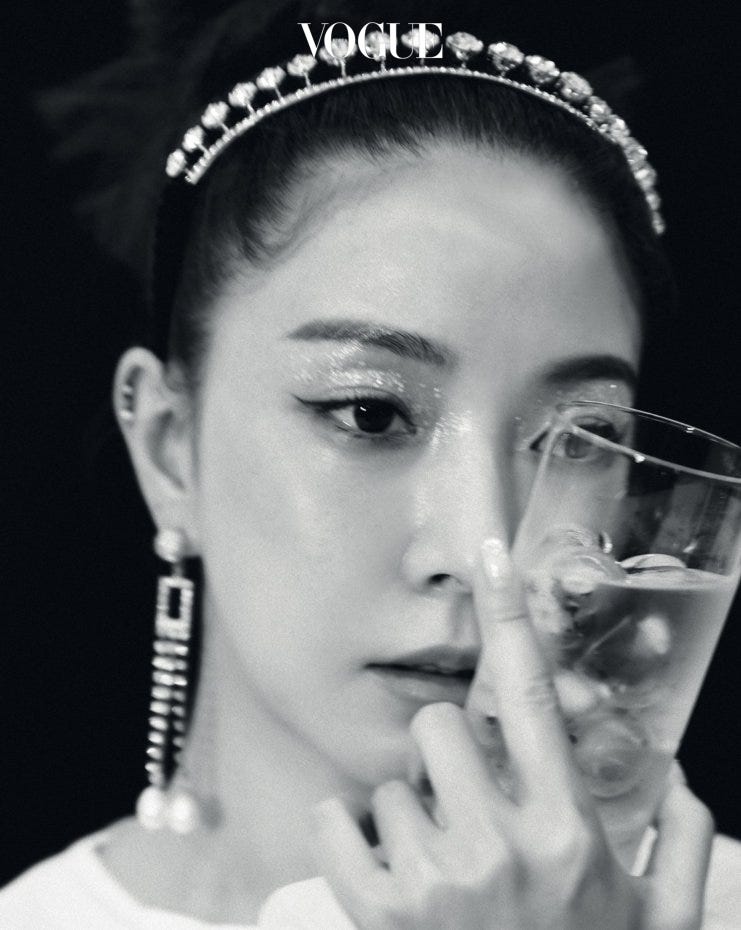
BoA for Vogue Korea 2020 September Issue

Amid a flurry of recent online conversations recently about the now growing consciousness of Spotify CEO Daniel Ek’s defense contracts and the grotesque hypocrisy of his mission statement, that is “empowering artists” and “creating conversations” while “funding the never-ending war machine”, I began thinking about the way boycotts had been seriously claimed in our cultural lexicon and their strange cultural afterlives; of how they have been represented, misrepresented, effectively deployed, reinvented, in this case, or otherwise misused. One word, boycott - a term easy enough to associate with a particular, or peculiar, form of unionist levity and moral hardening - is basically a lexiconic relic revived, and might have been an appropriate runner up word of 2025 if “slop” hadn’t been so decisive in its claim. Spotify, earnestly angling to be the Raytheon of the culture industry, sits at an interesting juncture between many of the ideological and aesthetic concerns of the past few years, and thus has (perhaps rightfully) been identified as worthy of suspicion. And so this is how we find ourselves here, in a time where the usual terminology has been pilloried of its original meaning.
That the consumer boycott is now the only comprehensible form of action illuminates less about our ability to buy or not buy but about how little power we had left to squander on collectivity outside of purchase power. But that is a thought for another time. Easy enough to find myself here anyway, on my strange little personal electrocution device, thinking about what it might take to follow a necessary modern boycott, that is, to give up spotify and migrate over to an alternative - in my case, apple music.
Apple Music is a wet blanket of a platform: flat, somewhat novel, indistinct in a way that seems ashamed of itself. It’s hard to think of the once ubiquitous ipod shuffle ad and reflect on whatever naive charm I may have once regarded for this brand. (Of course, there is an explanation. I was 14.) The promise of playlists curated by artists or boiler room style setlists by guest DJs (I can smell the Santal 33 through my phone) did little to usher me back to the streaming service. Switching platforms isn’t just irritating; it lays bare how profoundly Spotify had reshaped not only my habits but my sense of what pop could sound like. For years it was my main platform and, I’m sure, due to some extemporaneous/accidental promo on behalf of friends with the “spotify wrapped” thing (vaguely accurate but unconvincing, surely generated by AI and devious gay interns, like a horoscope written by a surveillance drone) I moved back. Because I am not above vanity, I accepted the data gathering exercise of it all, posted my results at the end of the year, eyes wide with fluoride, used the app reflexively, ideologically bottomed for big tech, and stayed put.
Spotify, for all its obvious moral vacancy, knows exactly how to seduce a user into the ideal formations. What necessarily appeals to users about the app is their natural inclination to go down rabbit holes, or indeed, to “surf the web” - to follow leads, to draw associations, to discover something new where there were no previous inclinations. Getting lost in the midst of one’s own desires is only human. It is a pleasant side effect of previous consumer relations, this ability to identify slippage between the self and its unconscious. Once, music fans trawled through forums and discogs to access this feeling. The point was to feel like the first fan, the most knowledgeable fan, the prized fan, a zesty kind of competitiveness born of love that ever so slightly upped the stakes. It dared you to know more and therefore to care. Brian Eno once said people should “stop thinking about art works as objects, and start thinking about them as triggers for experiences.” I don’t think it’s an accident that the people I know who seek things out, who stretch the limits of their attention and time to look for things, to keep on pursuing outside the realm of what’s offered to them (whether it be by mass media, their immediate circles, the dictates even of a purportedly open minded creative milieu) are some of the most interesting people, and more often than not, the best artists.
Spotify co-opted that instinct and made millions, all at the expense of artist, who would have once felt some kind of mutuality on behalf of fans, creating an interesting loop. The loop is effectively closed, and there is only a one way stream from the artist onto the fan, who demands more and more at very little price. Ergo: what fascinates us about Spotify, as consumers, is abhorrent to the producer. The quote by Lauren Berlant about “the story of your life becoming the story of the detours your life takes” becomes, in this case, instructive (if you want to really stretch the meaning and think instead about style.)
Algorithms, obviously, do not encourage detours. They give you what you already wanted, what you almost wanted but didn’t quite reach, what someone like you has wanted before. These affiliations often do not account for the haphazard nature of human interest, or expression. Algorithms resist the element of surprise, which is perhaps the most understated - but essential - feature of connecting with a pop song, as proven by studies, which I am too lazy to include or reference, and you should google it. That feature has been all but excised from the mainstream. Marilynn Robinson argued that what is true of art generally is that “it occurs among a continuum of expectation fulfilled, however surprisingly, and expectation disrupted, however profoundly.” Which is to say, if I was fed everything I wanted instead of having the onus put upon me to develop my own taste, I’m not sure if I’d have any.
I missed this activity, not realising that I’d become totally sewn into the mechanics of Spotify and alienated from these instincts; at first, I balked. I dislike being made to do anything, which a psychoanalyst once asked me to “investigate” which I responded to by “never booking an appointment with him again.” After being so accustomed to one interface, it felt unusual to readapt to one which seemed too uniform (and not inured from the trappings of its competitor) until I remembered, helpfully, that the itunes store predated the invention of Spotify, with access to deep cuts, overlooked albums, b-sides, and single releases. These exist by way of pure bureaucracy; record labels simply would not have thought to add to the competitor streaming service, as much as they were desperately sought after by fans. Gay guys love to find oddities and rarities, it is an evolutionary link that connects us to our most ancient ancestral forebears, by which I mean assigned court eunuchs who pilfered rare flowers from forbidden orchids to offer their favourite queens. The internet forgets what it can’t monetize, and Apple, for all its cryptofascist branding, is at least a kind of archive. Remember “iTunes exclusives?”
Anyway, the service through which music is delivered is one thing; but what these little rediscoveries have illuminated is how pop music used to sound a lot more interesting. The late 2000s were the last documented moment when the “producer as auteur” was still a viable category, where producers and their peers treated pop like a force of both engineering and the erotic. R&B and electro-club collapsed into each other, giving us the serrated synths, pneumatic drums, and hyper-processed vocals that defined the era.
One such album of that era is the self-titled album by Korean pop star BoA, one of the first attempts from a k-pop star to attempt a crossover into the English market. I discovered this album at 17, on those barely there, desperate to be replaced school computers in the free rooms, surely home to several antibiotic resistant bacteria hosted only by teenagers, where I’d read the wikipedia page for upcoming releases while avoiding assignments. That page was my pitchfork. That year? My bestie. That school? My personal amphitheatre for performance art boots. Given that it’s not identified as itself on streaming, and probably because it sold almost nothing, it’s barely remembered now. The singer BoA hit the scene at what, 15? At an age when most of us were figuring out who we were in the world, she was living 10,000 lives in front of cameras, her name reverberating across Asia, long before the West caught on, or heard of acts like “BTS.” Meaning: she would have been famous for over 15 year before her english album seemed feasible, or doable. Released in 2008 with a star studded producer line-up, it’s indulgent. At its helm lies some of the most over-worked, yet insouciant producers of the time who, bizarrely, were also the most underappreciated: Bloodshy & Avant, Sean Garrett, Brian Kennedy - names that should’ve been household names the way their peers were after their collaborations with American pop icons. Here they frame BoA’s sound in a way that’s precise, engineered for pleasure without any sense of pretense, and sleek as hell. “Eat You Up” is the opening track, and it is the moment you realize what BoA is attempting: not assimilation, nor necessarily translation, but sheer audacity. Every track is geared for easy listenability, stripped of any artistic contrivance, fully sonically engineered for the era of Dr Dre beats head phones, where pop music, hip hop and RnB privileged the separation (and individuation) of separate stems and their legibility over any so-called poetic license.
How could a song be engineered to sound as dynamic on headphones as it would be in a dance studio?
This is the context for BoA’s self-titled album, and a helpful explainer for the musical environment it was born into. Around the time of its release, BoA relocated to Los Angeles for nearly a year. She must have had the time of her life visiting the swans at echo park lake and losing time in the organic grocery stores; but maybe not. Official testimony reveals she spent her time living out of West Beverly Hills while working with American producers and choreographers. Perhaps the dry heat and distance and atomisation set in quickly. Later, she described the experience as isolating - “a singer from abroad feeling detached,” she said. It’s a rare admission of vulnerability from someone who seemed to embody the industrial fantasy of transnational pop without any friction. “BoA” was one of the first attempts for a k-pop star to break outside the confines of their market in Asia (BoA was arguably bigger in Japan than in her home country) to make it into the American market.
I say k-pop with some hesitation. When we hear that portmanteau (?) now, we think of “pop music” as an obliterative spectacle. Less a genre than an experience, a realm, modern k-pop seems engineered to completely overwhelm the senses in some kind of all-out assault. It’s cocomelon with higher production value. It’s designed for ADHD adults and teenagers who don’t stand a chance at growing into anything else, having already long lost their battle with the giant that is digital media. Short-form attention economies dictate the delivery. Narrative is more or less irrelevant. K-pop aims to appeal to the attention deficit in the way only it can, through old school parasocial ties, overwhelming production, near olympic forms of athleticism by way of choreography, and hyperbolic music videos. “As Kylie Minogue said recently, k-pop is what happens when you take a regular pop song and ‘totally turn up the dial.’” I don’t mean for any of this to be derogatory, by the way - I watch k-pop videos the way I don’t watch regular music videos, if only to see what it’s like to watch someone being very good at their job.
Observing a k-pop fan helps to explain the etymological connection to “fanaticism” in a way we might have once forgotten, literalising it more than we could have thought possible - a reunification of meaning. I have suspected, based on my own “research” that it is totally normal to act somewhat like a tweaker in response to a Blackpink song coming on at the gym. Though there is some of that going on here, BoA exists in the interstitial space between cultural shifts. In its attempt to replicate the trademark of others, it created its own. And by that, what I probably mean is that it thrives in the cultural fall-out of Britney Spears blackout. Moreover, I believe BoA exists in what I will tentatively call the Blackout extended by universe.
BoA came out in 2008, the same year as the financial crisis, which made opulence feel obscene and, perversely, more necessary than ever. Every sound from that period is stripped of message and metaphor even as it works overtime (through psychobabble) to convince you of something - mainly, that the world hasn’t collapsed. Everything, which in this case means the economy, is actually totally cool and generally fine. Britney’s now legendary record had emerged one year before, rewiring our idea of who the pop star should be (everything and nothing.) Blackout is the gravitational field that all true “pop products” orbit around, and not for reasons you’d expect. Its success lies in its ability to be meta in the ways it needs to be without ever getting too uncomfortably close to real life; these are my favourite kind of pop songs and I won’t elaborate.
I can list some helpful examples of albums that hereby belong in the Blackout extended universe: albums that were either commercial or critical failures but now seem ahead of their time, if not totally avant garde in their indifference to taste, which is to say, relevance. A lack of penmanship on behalf of the singer finds parallel in the abilities of its overly skilled producers, who treat the songs and album like a showcase for their talents, rather than that of the singer, creating glass vitrines of sound. A somewhat fleeting sense that the album’s creation was expensive. An instinct for trendsetting. These albums sit at that strange cultural juncture where the maximalism and mechanical precision of late-2000s pop collided with a sense of dislocation, where artists acted as avatars within the machinery of global pop market and its obvious connection to vulgar market dynamics rather than as fully embodied authors. They are also an interesting sound bite of what we once knew of as “the monoculture.”
Much has been written about Britney Spears blackout, but I haven’t heard much in the way of why it was so interesting, and so musically successful despite the ambivalence of the (cultural) response at the time. In “Framing Britney Spears” (2001) her collaborator Danja claimed that she was deeply involved in the creative process, writing “the lyrics to blackout on the back of restaurant napkins.” It’s a legendary anecdote, albeit a surprising one. If this is indeed the truth, we would have no way of knowing it. Where is Britney in blackout, or - should I rephrase - where is the Britney we know? Blackout had none of the intimate revelations of albums preceding it, the digressions which gestured to her image or any lyrical, personal insights that could have seemed autobiographical. On the contrary. Songwriters employed to create songs for the album noted that there was an unspoken rule for Britney to not refer to her private life (if such a thing even existed at that point.6 Blackout is an album about escaping the self, rather than exploring it. On “piece of me” the vocoder and autotune was so glaring that for many years it was my least favourite Britney song, the timbre of her voice completely swallowed up in crunchy processing; I could barely tell the backing vocals were MISS Robyn Carlsson.
Dance and sex were her avenues for transcendence. “That’s the whole point of it, to lose yourself.” Said Jacqueline Rose, of the latter. For Bataille, The “I” was a kind of prison - he went on record to say that ““I am myself only by the loss of myself.” Britney seeks to understand by letting go of the concept of seeking or understanding. You will not find any personal anthropologies on Blackout, but without these admissions there is still much to glean. Rosalia said recently that keeping one’s heart open to empty space is the way to invite god in. She was quoting Simone Weil, probably, which so many artists love to do now; this is, by now, not an unpopular sentiment. So it is the case that in the absence of diaristic input blackout instead comes to be a document less of Britney Spears than it becomes a vacuum, its apparent “vacuousness” opening up plentiful space for the detritus of the time to rush in, to become - finally, suddenly - evident.
And what does it reveal, except what the keenest ears already knew? When given the slightest license, the Black producerati of the time could make some of the most compelling dance music ever produced, tracks that maintained their RnB bonafides while reinventing the hegemonic sound of euroclub from the ground up. An article for Wired, in 2003, “introduces” artists like The Neptunes and Timbaland (as well as Nigel Godrich and DFA, and whoever else made sense to self-serious men with headsets, just to explain the tremor) helpfully illustrating when that shift began to happen - to unconsciously reunite those genres with the initial instincts that informed them. Tavia Nyong’o’s work, too, might be instructive here, coining the term “afro-fabulation” to describe a strategy of challenging “tokenizing mechanisms” that “reproduce invisibility through the guise of empowerment.” One of the main producers for Blackout, Danja, claimed that he was “left to do pretty much whatever I wanted to” which is producer speak for saying: nobody was watching over his shoulder. His presence is everywhere on the album, but he is more or less invisible. The invisibility served like a permission slip. A voice could sound like a synthesizer, rather than a vehicle for confession, for instance. Simon Reynolds once called the “post-human” tendencies of electronic and pop music in the 2000s, where “the voice becomes a texture, another element in the mix, disembodied from the singer.” Almost every major hitmaker and genius of the day was recruited to make Blackout a marvel of contemporary popular music, getting so close to pure sophistication that it still sounds innovative now. The glaring exception to the lineup would be Timbaland and Justin Timberlake, who in the soft-focus chaos of Britney’s “crash-outs”, offered to “help her out” both personally and with her career, to make sure she could get back on track and escape the fallen image projected on her. Britney did not accept any assistance from Timbaland to get a “hit.” Eschewing the biggest producer of the time, Britney got at least 5. One song on the album was so good that they recycled it for the album that succeeded it. Lightning doesn’t strike twice, but apparently a woman can.
“Why is it that Blackout sounds vital today where FutureSex sounds limp, though Danja’s fingerprints are all over both records?” speculated Meaghan Garvey, for pitchfork. “Spears understood something Timberlake didn’t: Abjection is a powerful aphrodisiac, and desire requires a void.”
Critics at the time noted this uncanny distance. Kelefa Sanneh, writing for The New York Times, described Spears’s voice as “flattened, mechanized, a ghost in her own machine.” It is in that void that we find ourselves wanting, and read the tea leaves. The late 2000s were for the showgrounds for celebrating personal instability insofar as it foregrounded political instability. One became a cipher for the other in a time where we had less of a desire for disaster porn. For Sianne Ngai, the pop stars existing in the blackout extended universe are “zany” - her way of ascribing a certain kind of sensibility that equivocates to hyperactivity, multitasking, and the exhaustion of contemporary life. These pop stars are not using their medium in any forthright manner as much as they want you to see them sweat. Nothing about them necessarily is “relatable”; in this era, an absence that could only warrant a sight of relief. BoA, whose every movement in the “Eat You Up” video is executed with impossible precision, as if it was designed solely to be mimicked in amateur hip-hop choreography classes the world over and projected back on endless surfaces by way of youtube. She was an aspirational figure, not a relatable one.
As an experience, BoA is tightly wound from start to finish it starts to sing through it’s teeth. If Blackout’s lack of a mission statement became its own, multivarious mission statement, BoA became one too. That is, quite simply; what is the impression of an outsider on present day American pop music, and what makes it truly compelling, if it isn’t exactly flattering? BoA did the field research and the album is her returning to us with her findings. These songs represent her view on the American psyche. Songs about being desperate for love, disgusted by love, in despair at the suggestion of love, love as delirium tremens, and generally being out of control in the club, all expressed in the form of self sabotage style post it notes across a sonic minefield. There’s nothing unusual about the lyrics, until you take the time to understand them, which is arguably not the point. The speed of the songs seem to adjust uncannily on what you desire as a listener. Impressions are not lasting, designed to hurry you along through the music. It’s as if BoA believed American listeners have the attention span of a lit fuse, and so she overloaded the album with tics, switchbacks, glitches, hooks, to the point that it’s almost redundant. It’s often jarring, if compelling and strange and hilarious - an oversimplification (and in some ways an overestimation) of the (assumed) hi-fi sensibilities of listeners. “Underneath the setting sun, something wicked this way comes” she utters, at the beginning of “Scream” which sounds like an attempt to conjure MJ with an utterance that is wholly unrelated to the theme of the record. As to be expected, only k-pop fans and gay men bought the record, or knew of its release.
To this end, you could name obvious examples that follow on from what’s described: Heidi Montag’s superficial, which in the years following its debut was viewed as one of the worst records in the world, only to be reinvigorated in recent years as a forgotten classic. Nadia Oh’s debut. Nadine Coyle’s insatiable. Some of the leaked Lindsay Lohan singles (which have been cited by Charli XCX as influential) and that Tiffany Trumpy single that was so coated over in autotune as to make the voice resemble a synthesizer, released straight to amazon music that sounds like it pre-empted the invention of nu-pop stars like grimes (I’m not even joking.) Kylie Minogue’s X feels, too, like something of a useful example - still, what separates BoA’s self-titled album from her Western counterparts is the asymmetry of access. The same producers who granted Britney the luxury of reinvention demanded from BoA something closer to proof - fluency in a language that was never written for her to enunciate. To sound “American” meant to surrender authorship. Which is to say: you become the version of yourself as seen by others, rather than the self you aspire to portray.
In a sense, the pop star was a sounding board for genius swedes and seasoned hip-hop producers moonlighting as futurists, who had some license to be as eccentric as possible to account for the simplicity of the lyricism and artistry. Many of the albums released in the attempt to breach the english market were not commercially successful, and in many ways a failure, but created some fascinating songs. BoA, Utada, and later 2NE1’s CL all ran up against the same paradox: the dream of borderless pop was real, but linguistic, racial, and aesthetic biases still shaped the Western market. The Western market’s notion of universal pop often masked a narrow aesthetic built around whiteness and Americanness. BoA was meant to be a massive breakthrough, but sold far below expectations; some people don’t understand how a quote-unquote failure can also be an almost perfect album, but I can’t think of any other kind.
I have some nostalgia for this era now, where every second song had Darkchild’s hand in it, or DJ Mustard’s signature, given how “overly palatable” pop music has become. I listened to recent major label albums and, aside from the immediate sense of enjoyment they offered, felt like they were the musical equivalent of eating butter. So many of the sharper edges had been taken to with an angle grinder to remove any sense of incident, from the possibility of deviation or surprise. I don’t even fuck with k-pop like that; I have to turn over the radio station whenever that Rose and Bruno Mars song comes on. Our sonic palette seems to have become overwhelmingly conservative, and we are currently witnessing what seems like the third “country revival” in 10 years. Visionary producers still exist of course, but they have either not breached the mainstream, or have acquiesced to the belief that mainstream recognition is only one form of success. It’s just as well. Why risk the exposure? Listeners are far too cautious now to notice.
In light of these revelations, BoA is a fascinating document. On BoA, the sound of ray guns sound off over a midi bass line. One “voice” is made to sound like 5, all of them altered and pitched to their fiercest pitch, autotune fully maxed out. It is an attempt to distill the best, most artificial, high intensity qualities of late 2000s into a form that works too well to have succeeded in a country that is ultimately more conservative than any of us realises, despite how much innovation it may have contradictorily produced. It is an album that demonstrates how J-pop and k-pop of this era synchronised with the producers of this time, and when they took inspiration they did so as homage, rather than cheap parody - which, as we know, the mass market often privileges. Boa once said that she “felt invisible in America…I didn’t know who I was singing to.” Misunderstanding her audience may have not made for sales, but it may have made for one of the more bizarre, demented, and fun pop albums ever. For better or worse albums like this don’t get made anymore, not because the talent is gone, but because the architecture that once made them possible no longer exists. It is an album attempted way before k-pop stars knew to adjust expectations, and to play a role: a k-pop star pretending to be the version of themselves that Americans want to hear, rather than a k-pop star becoming an American. Even now, the reflection is far too dizzying.