Near the precipice
Felix González-Torres - “Untitled” (Cold Blue Snow) (1991)

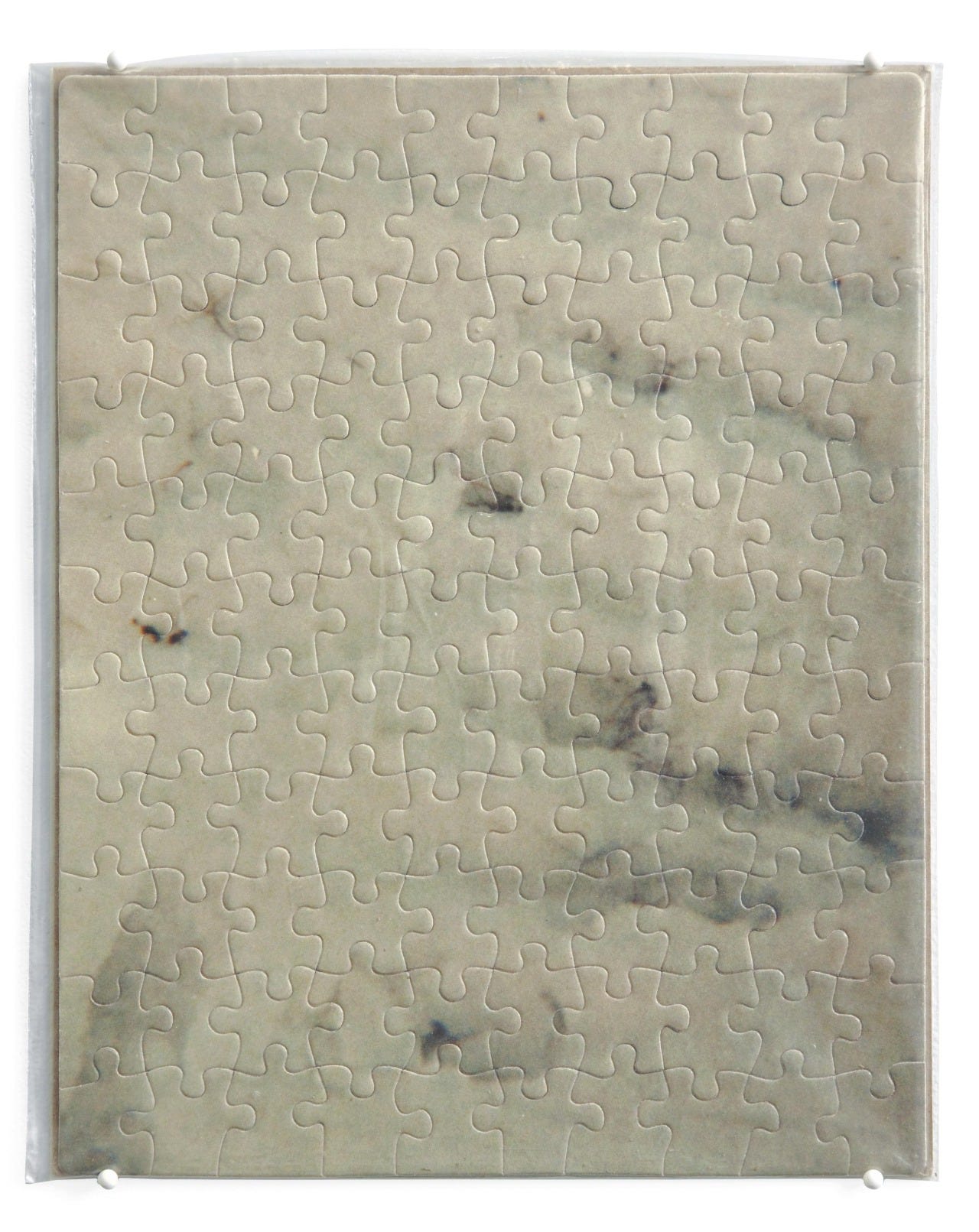
In what way should an essay start - or is this it, barely a preamble, a half-measure? Or is it the case that the essay begins like weather. The climate decides on what movement or non-movement is necessary. The utopia of absolute cold keeps its subjects enclosed in a tidy arrangement. Say you’re living recklessly on an unseasoned day, say you’ve forgotten your sunglasses; say you’re a driver, careening down a 120 km/ph road one day and the frigid, impossible memory enters you like a passenger flying from the wreckage of one car into another, and the image of it altered everything, every cell of you. Say you’re a distractible person, and little graces escape you. Maybe it was a memory that had seemed important for so many years until it wasn’t, and then it summons itself out of the earth or some unnamed section of the stratosphere and speaks to you, asks you to come back to it.
In this case I’m 7 again and awash in some great white image of the snow covering a great expanse and my whole family was there, and I wasn’t sure if we had visited it intentionally or happened upon it, or if it happened at all. But language feels incalculable against a failed memory. The words work as a pantomime of lyric. The lyric, the fragment, the cinestile permit a level of soft focus which cannot be so easily attributed to crude analysis. So there we have it. The point is to hone in on something forgotten with the intention of bringing it back to life, because the feeling attached to it is so potent it needs the spirit of language. I feel like Mary Ruefle asking: “What form does a lecture take when one has nothing to say?” All that black nothingness accumulates like material in the unforgiving centre of this memory, which is not an essay. The memory and the essay suggest different goals. Or do we give up and take the writing to the snow?
That is where I am tempted to go, ever since that moment in the car and the weeks after actually, if only because it is so rarified. When something vibrates like that in the halls of memory it isn’t for no reason - it is here that the generative work flows. At least, as long as you can cast your eyes over it, importing no judgement, value, or heaviness. There is no point assigning it a dictum. The potency is created amidst the purity of the snow, with no agendas, and pure life is what we are after. Marguerite Duras says it is “a sacred word in every society, in every language, in every responsibility.” The cleaner the distinction between other environments, the more desperately I find myself drawn back into their texture.
The phenomenon of snow does not occur in Australia, anyway, except in exceptional conditions, in the high country of Victoria or the Snowy Mountains of New South Wales. Yet my encounter with it took place in neither. When snow does fall, it arrives thinly and without applause, in partitioned areas, usually somewhat randomly, always magically, whitening the ridgelines before retreating into melt by afternoon. Which is to say, in this memory we were somewhere near the hills.
It is especially insane to experience as a child. We are gathered on the hill. Well, it’s a slope of some kind, and even then I’m not sure. Aren’t you so excited to be seeing real snow, someone is saying. Someone else is wearing a beanie. Someone is tracing their steps and seeing how their boots leave impressions. Some stands to my right and other families with children are gathered close. I’m noticing how the snow is actually quite crunchy, when after all those years seeing American films I expected it to be like play dough or icing sugar or feather down. It’s because this is ice, someone is telling me, and I’m saying how could this be true, if it were made of the same molecules wouldn’t everything be different?
Scientists observing Australia’s relationship to snow say its seasons are shortening and its snowpack thinning, that what was once reliable is now episodic and fragile. It has no purchase in our cultural imaginary. Indigenous records of snow in the country have suggested that it was never an anomaly but part of a longer climatic memory, held in story and seasonal knowledge. Historically the first instance of the noun memory in ancient Greek thought is less a storehouse than a kind of force—Mnēmosynē, the mother of the Muses, the one from whom all telling proceeds. What we call remembering was understood less explicitly as a form of retrieval than as a bringing-into-presence, a making available to speech. In Theaetetus, Plato gives the figure of memory as a block of wax in the soul, impressions pressed into it by experience, some clean, some blurred, some already failing at the moment of contact. Aristotle refines this in De Memoria et Reminiscentia, where memory becomes the persistence of an image (a phantasma), a trace left behind like the mark of a seal - something dependent on the condition of the body that receives it, too moist or too hard and the imprint will not hold. Memory was already subject to variation, distortion, and decay, shaped by the material that bears it. Best of all is Aristotle’s insistence that what we remember is not the thing itself but its likeness, held at a distance in time:
τὸ μνημονευόμενον ἐστὶν εἴδωλον
(What is remembered is an image.)
It’s the driving all the way into the accumulation of the snow. It’s the sense of wonderment as this thing you’ve seen all your life but never encountered springs itself on you, changing you. The way grandmother waits in the half drift half sunken snow. The car sleeping quietly some distance off lightly blanketed in snow. The bewilderment at your place in this small universe, how it has altered itself for you. The trip to the far off place, which is, the location in which there is snow. In this country we don’t see it; we learn of Christmas and the antipodes and immediately recognise it by the obvious lack of snow. Therefore, the phenomenon remains a novelty. The poem like a memory that generates its matter to tell of the quotidian in the form of snow. Its syntax works to rearrange what is wrong, to spell out the true nature of time. Simone Weil said: “If we behold ourselves at a particular instant—the present instant, severed from the past and the future—we are innocent. We cannot be at this instant any-thing other than what we are; all progress implies a duration. It forms part of the order of the world, at this instant, that we should be such as we are. All problems come back to the question of time.” The sole purpose is to capture the minute seconds of this memory and placing them in a collegial way among the other indistinct parts. It serves no purpose to burden it with any other calculations. You could ask instead: what is the temperature of this recollection? Nobody could possibly answer. The colour suggests otherwise, maintaining a pulse, a thrust, a vibration that ushers in the need for words that have no sanction.
A big face appears like the shuttering of the camera. I’m somewhere a few feet away and with my mind I psychically arrange them closer together. The faces flip between three or four different frames like someone dropped the vhs and the movement begins to glitch. No one’s face is the same, no one has aged, they appear the same as they do today, and an eclipse in the form of an ink blot blurs across the sections. But aside from that, it’s really all I can remember.
The big fluffy overcoats in the snow. This town could be called Thredbo, but it did not feel so far from Adelaide, and I would have recalled plane travel. The absence of distinguishing features that bely the snow. The spectral uniformity of the snow. My grandmother seems to think we changed across it accidentally, but I’m not sure if that was true. My parents seconded her testimony. Apparently we are somewhere near Stirling. We are gathering both grandchildren and grandparent to go see the mystic, who lies beyond the perceptible threshold. Except there is no mystic except for the weathervane atop a house that looks like a person. The only expression that is reliable and repeatable in any real sense is the smiling, with the backdrop in the snow. The little threads woven through the puffer jacket probably designed and assembled in nippon to brace oneself from the snow. Not knowing in the memory if the sky is falling too or if we just stand in the debris and wait for the ruinous sentences to catch up. Here’s Ben Lerner: “I’ve seen a wide variety of symmetric shapes growing as they fall, have caught them on my tongue, the spike proteins of the snow binding with memory, producing some immunity, which then fades.”
The pure blank whiteness of the snow. The unbelievability of the snow. The sense of awe at that unbelievability, the whole body spilling out on the snow. The sense that the ecstatic could be reparative in the snow, even then, a realisation functioning primarily as a form of thinking without conclusion. As if it could ever be amended. As if the mind could be briefly persuaded to create the matter, to go lie down in it. Replacing the landscape with the relief of its overlay, it allows a cleaning of the mind’s disorganised interiors. To write about the snow is therefore to write about what has gone unavoided. Anne Carson - “As we talked I was watching snow drift down the dusk outside, counting it, one hundred and five, one hundred and six, one hundred and seven, when out of a pause she said: ‘It’s funny to have no home’ – funny being a funny word for what she meant. I say this now to remind myself how words can squirt sideways, mute and mad; you think they are tools, or toys, or tame, and all at once they burn all your clothes off and you’re standing there singed and ridiculous in the glare of the lightning.”
Words that remain ungovernable. Prayer hands that clasp at half mast. Deep inquiry into the existence of oil extraction. Chorus of bees translating the word “almost.” Songs that play on the radio 70 times then get abandoned. A speech from a politician who forgot to be a real person but believes in the oral tradition; his voice is vanishing. Words that drift on down from the alpines. A museum guard on a chastened cabin studies the exit sign as if it were a horizon. Someone is holding a camera. Nobody can relate to me if what I remember is real. I don’t know which way the mountains bend. I can’t tell if someone was telling me to smile or if the memory took the shape of a smile. Wringing, wringing, wringing. The future arrives wearing yesterday’s perfume. Define “heat death of the universe.” A footnote blooms where the family should be. Every time you have a near death experience the timeline shifts, and what you witness now is a quantum leap.
The more you know, the more you understand that there is greater material in the universal that is profoundly unknowable. For every piece of matter or tome or lesson is the exponential switch in knowledge, the ever deepening contrast, a sense of bliss, maybe, in surrendering control. Part of this is time, yes, but partly also creative control, partly also the bias of distance, partly the exasperation of making something of which you seem to recover no detail.
Years ago my grandfather, the same one I see in these memories, was found to have black matter on his lungs which they identified with scans. Little details found in x-rays, ephemera scattered across the surface of his organs. This morning they called an ambulance to the house because he said he couldn’t breathe. The longer that time passes since we went to the snow, the less reliable my recollections become of him at that age, fitter, healthy. He spent most of his life, since he was 12, smoking; as far as I know not a single one of those cigs is one he regrets. My worst fear is that the memory will become negligible, as indistinct as an old newspaper. That tension is the same one that lies under everything, the one that propels energy forward, and cannot be so easily confronted. It maintains its essence here in the indiscriminate cold. It’s the surface around which all the old fears orbit. A memory looks different from 5 years ago. A memory looks more like a shared memory 10 years ago. A memory starts to look like a vhs 15 years ago, and by 20 years like a degraded film, and here is where things start to get interesting. It edits you out of certain frames, splices in a stranger’s hand where yours once was, blurs together parts of different memories, and fidelity gives way to texture. What the actual image “symbolises” is never as powerful as the changing nature of the mind’s technology as it tries to keep pace with it.
The essay then, if it even is one, keeps failing toward form. Still the form is all there is. What a disappointment, you might think, but then - relief. Fanny Howe says “In some form or other, the deformity of the form is always potential as opposed to immanent. Perfection requires attention.” In fact, she has a lot to say: “The idea behind the structure is often a social convention, a moral lesson, a warning, an encouragement.” It circles the scene the way a car circles for parking, engine still warm with the evidence of many other scenes fast forwarded and passed through and glimpsed elsewhere. These little efforts to piece together falsehoods. Attempts to mirror the fracturedness of what is by submitting to its inelegance and strange logic. Perhaps the effort to make it something overloads the scene with tension. Perhaps the choice was never ours. Sartre said that, for the writer, “it is like an immense and vain effort, forever arrested half-way between sky and earth, to express what their nature keeps them from expressing.” He believed that the words worked when there was nothing much to say. The intention is to enhance the spectrum of feeling allowed in one image without needing, necessarily, a fix.
What retains its shape is not the experience but the pressure it exerts, a little thumb that pushes up against the temple, rubbing it slightly, uncovering some long forgotten wrinkle. Below there is no stain. There are no certainties. There are no indices. There is no continuity, no shared technical vocabulary from which to draw from. Everything is perfectly abstracted. I’m standing from 20 feet away but those feet are years, actually, and the thing I’m watching seems as if it’s being played from inside the wormhole. I have handed over my despair, my control, my perfection, all to be swallowed up, and my attachment to go with it. What exists is the urge to write it over and over in different ways until the image thins into something.